Showing posts with label Gen Y. Show all posts

Monday, June 23, 2014

15 Reasons why the New generation uses Facebook

Don’t be surprised when I say that 81% of Generation Y (born between 1980 and 2000) use Facebook or that a whooping majority of Gen Z (born after 2000) are constantly ‘connected’, are emotionally attached to their devices and they prefer to connect online more than face to face.

Gen Y is now their 20s and Gen Z are now kids or getting into teens. Together they make the new generation. I am sure you have one of them near you -in all probability in your family as your son or daughter or in your school/colleges as students or in your organizations as an employee.

The new Generation feels that it is very important for them to stay connected. However since they are constrained with time, even as they call themselves a bit ‘socially lazy’, they prefer 'online' to stay connected. The new generation is heavily connected on social media, for personal, social and professional reasons.

Despite the advent of other instant messaging services, Facebook outscores everything else in social networking. My research on the new generation has thrown up reasons behind the continued popularity of Facebook . New Generations feels Facebook helps them to stay connected and use it for one or more reasons.

Here are the top 15 -

  1. The new generation is generally curious and Facebook helps them to know what’s going on in the lives of others. It also helps them to know personal things about other people in a very impersonal way.

  2. Facebook helps them stay abreast with the major life events of their friends and acquaintances.

  3. It helps them to bridge the gap of distance and time that they suffer with their friends and remain in touch.

  4. Facebook helps them to forge and nurture relationships. Birthday, anniversary wishing is very common.

  5. Many use Facebook to engage with brands.

  6. Facebook helps them improve their networking skills.

  7. They use Facebook to maintain close friends-group camaraderie.

  8. Facebook helps them compare their life and live an aspirational life.

  9. At times even brag, boast and make others jealous or simply get the ‘Likes’.

  10. Facebook helps them to know and share interesting stuff (updates - information, photos, selfies and jokes).

  11. Helps them earn virtual currency (for example Facebook Credit, Farmville Cash and Microsoft Points).

  12. Promote their work (Facebook pages).

  13. Search lost friends.

  14. Seek help.

  15. Beat loneliness.
Some of them also use LinkedIn for professional networking. They also heavily use their smartphones and messaging apps like Whats App to stay connected. Many are constantly on Whats App.


What’s interesting is that the line between online and offline is blurring for the new generation and for them it is parallel existence in both these worlds. They find it strange when their parents, teachers or employers ask them to give up their gadgets, or come out of the online world or restrict their social media usage. For them the online and offline world are one and the same, one diffusing into the other.

Tuesday, December 10, 2013

the gen Y blog

Please check my new blog - http://thegenyblog.blogspot.in/

Gen Y is the next big thing!!! They are ready to enter organizations in big numbers and are the largest growing consumer segment all over the world.

Gen Y is also the most misunderstood generation. This blog attempts to present the real Gen Y, with an objective to understand them better and engage them better.

Monday, October 14, 2013

The New Generation Army

Violent clash between the Army soldiers and officers at Merrut cannot be ignored as an one-off incident. Neither should it be read as an impending mutiny. But definitely the times are changing and Indian army seems to be a ‘generation’ behind!

The Incident

The incident happened during a inter-company boxing match. One version says that a solider tried his best but lost a friendly boxing match. One of the officers confronts him after the match, publicly ridicules him and thrashes him. The soldier does not take the insult lying down and retaliates. A prolonged physical clash ensues between soldiers and officers. The ugly incident leaves army red-faced and embarrassed.

As expected a committee has been set-up to inquire into the incident. And in all possibility the erring soldiers and officers will be reprimanded and punished. But will that really put an end to what seems to be a systemic issue brewing inside the organization. 

This is not the first ofsuch incident in recent times. In the last two years this is the fourth suchincident where soldiers have given back a fist for a fist. Although the top brass of the Army have come down heavily against such errants and have handed them exemplary punishments, the question is will that suffice. The repetition of such incidents, nevertheless, indicate that the problem may be lying elsewhere. 

Gen Y Soldiers

Gen Y is populating the Indian Army, like many other organizations in big numbers. If reports are to be believed then the new age soldiers are not only better educated but also more aspirational. This also confirms research literature on Gen Y. A more educated, aspirational and high on self-esteem Gen Y soldier may be expecting more respect from their officers.

In fact research literature indicates that Gen Y employees do not accept authority by the virtue of organizational hierarchy. They accept authority by example and for a limited time-frame. In other words, the superior gets respect not for his position but for the exemplary performance that he/she puts forth. The respect lasts as long as the such behaviour of the superior lasts. In the coming years, as more Gen Yers will enter the Indian Army, managing this new generation soldiers will be a challenge.

Structure and Leadership

Officers and soldiers are not only differentiated by rank but also by class within the organization. A clear class system seems to be prevail within the organization and treatment is not equal for the soldiers. A highly hierarchical structure ensures that soldiers at the bottom of the pyramid are only supposed to listen and follow. The power is highly centralized at the top. 

Culture

A rigid culture of command and control is highlight of the army. The same has been followed since the British Raj and this is perhaps one of the very few institutions that has been untouched by changes in past 65 odd years of Indian independence.

Control Systems

Carrot and stick in the all practical sense, the latter being used in both letter and spirit for managing the soldiers, as is evident from the recent incidents.

Such organizational structure, culture and control systems seem totally incompatible with the new generation inducts in the Indian Army. Organizations all over the world are experiencing the phenomena of multi-generations at work. The increasing tension between Gen X bosses and Gen Y employees is not only the problem of the Army but of many organizations around the world. The organizations that are able to recognize the fact are trying to decipher Gen Y and in the process trying to find out newer and better ways to manage and engage them. The others are blissfully unaware and completely in dark.

A seminal work highlighting the need to change the organizational design of the Indian Army was recently done as a Manekshaw Paper titled ‘Staff System in the Indian Army, Time for Change’ by P.K. Mallick, Centre for Land Warfare Studies, New Delhi (2011), and published by Knowledge World, KW Publishers Pvt Ltd, New Delhi. (article link).

There are enough indicators to show that the Indian army's ability to attract quality officers has declined sharply following the globalization of the Indian economy. Another seminal paper titled ‘The Indian Army Officers’ Crisis’ by Indian journalist and scholar, Dinesh Kumar, in the an issue of the academic journal, South Asia (vol. 33, no. 3, December 2010) is a must read to know the shrinking talent pool for the Indian Army. (article link)

Perhaps it’s time for Army to recognize the new generation at work and re-design a new internally strong  and united army.


Monday, September 3, 2012

Gen Y: The Reversed Happiness Quotient

Institute for Wellbeing Management, Bellevue University, Nebraska, USA, a non-profit consulting group on employee happiness, started a blog on Employee Happiness – tips, tricks & tools sometime back. They identified and involved 26 authors for writing invitational blog post every Sunday.


My first post for this blog – Gen Y: The Reversed Happiness Quotient has been published the Sunday Sept. 2, 2012. You can read the same here - http://employeehappinesstipstrickstools.com/

Please share my post with others if you like the same and post a comment should you feel like. I shall indeed be thankful.

Tuesday, March 20, 2012

Gen Y's pursuit of happiness

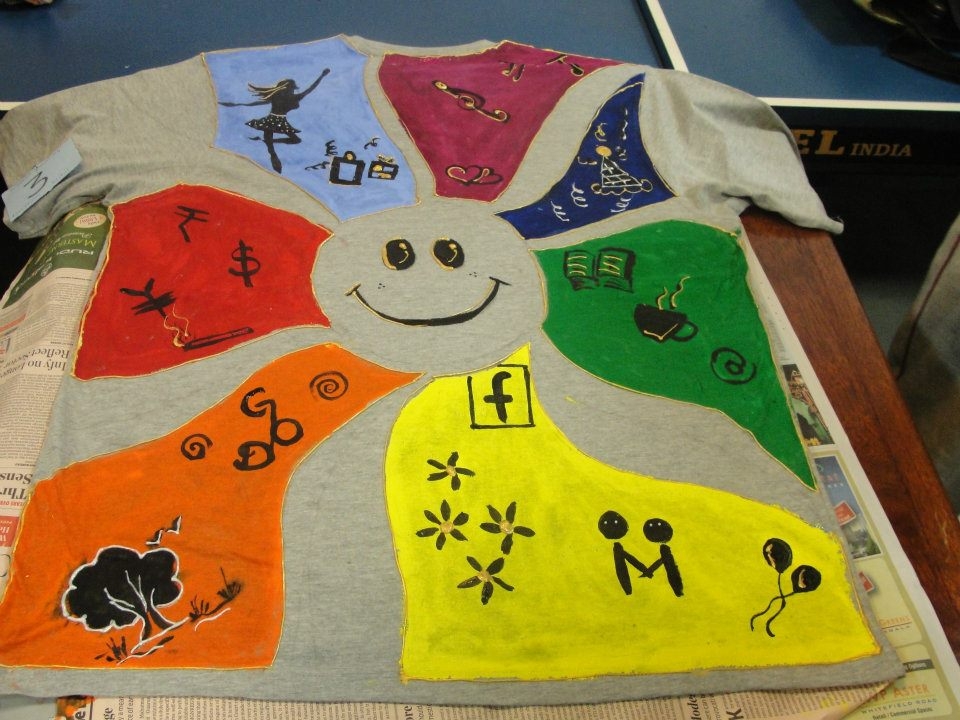
An attention-grabbing t-shirt painting done by one of my student Vidhi Surelia! The colourful hues and the meanings attached to them by Vidhi and her friend Shreya are not only interesting but I feel they have the code to what makes GenY happy… Here is what the colours & patterns say -


Blue – Dance, Shopping

Maroon – Music, Love

Blue – Party

Green – Reading books, Coffee (with friends at coffee shop or enjoying it alone), Surfing net

Yellow – Facebook, Flowers, Gifting others to make them happy

Orange – Nature, God

Red – Money, Material possession

At a time when India is on the verge of becoming a country with largest young working population and the companies finding it increasingly challenging to engage Gen Y employees, such impressions could be insightful, mapping this generation’s pursuit of happiness…

Friday, September 9, 2011

Breathing Offices

Expectation on nature of workplace has undergone serious transformation. ‘Gen Y and Workplace Annual Report-2010’ shows that workplace plays a significant role in not only attracting and retaining the Gen Y but also help improve productivity and creativity. ILO emphasizes on safe & non- hazardous workplaces play an important role in affecting the psyche of workers. According to ‘WISHA’ The work-related musco-skeletal disorders( WMSDs) account for 40% class of injury claims in the office eg. Carpel Junnel Syndrome.

Friday, June 3, 2011

Engaging the Gen Y

Perhaps the most exciting constituents of the Indian workforce are the Gen Y. The key is to 'engage' the most digitally sophisticated generation. However engagement challenges are absolutely different when it comes to Gen Y -


The ‘Generation Y and workplace Annual Report’-2010 by Johnson Controls is a watershed research on the workplaces for the future. The report clearly states – Generation Y is, perhaps,  who are looking for a sustainable environment offering a social structure within both a
physical & virtual environment. Generation Y is the working population aged between 18 – 25 years who are techno – savvy, diverse and demanding. The report indicates:
  • Workplace is important in attracting & retaining Gen Y.
  • Location of a company plays an important role in choice of a workplace.
  • Workspace allocation and technological provisions contribute to productivity and creativity.
  • Workplaces must be flexible & adaptable supporting both formal & informal collaborative engagement & interaction.
The report clearly establishes a link between nature of workplace and employee engagement. – ‘The workplace contributes to the level of emotional engagement of individuals with their work. The working environment of the Gen Y is a place they emotionally engage with; a space where they socialize in with other co-workers and a space which supports their health and well-being.’